AI agent development, with a person in charge.
An AI agent can read a request, decide the next step, and use tools to carry it out. We build agents that each have one job, their own permissions, and a record of everything they did, so you can trust them with real work.
A studio in Seattle, WA, working with businesses across the US. Fixed-scope builds, quoted per project. A person replies within 1 business day.
First, the honest question
Do you need an agent, or would automation do?
Workflow automation follows steps you fixed in advance. An agent chooses its next step. Agents cost more to run and need more supervision, so we only build one when the job needs something that can decide.
What we build
Agents with a job description.
- Inbox and intake agents
- Read what arrives, sort it, pull out the request, and draft the reply
- Research agents
- Look up accounts, people, or documents and report back with sources
- Sales follow-up agents
- Prepare outreach and follow-ups under approval and stop rules
- Operations agents
- Run the morning check, the status summary, or the routine triage on a schedule
- Internal knowledge agents
- Answer your team’s questions from your own documents, and say when they don’t know
- Coding and QA agents
- First-pass changes and test plans for a developer to review
- Agent teams
- A coordinator that hands tasks to specialists, with each result posted back where you asked
- Routines
- Work that starts from a schedule, a webhook, or an incoming email, with nobody in the chat
A good fit when
- The work starts with reading something a person wrote.
- It has to look things up before it can act.
- Requests arrive in plain language, not in a form.
- Someone on your side will own the agent and read what it did.
Probably not when
- The steps are the same every time. Automation is cheaper and easier to trust.
- Nobody has time to supervise it in the first weeks.
- A wrong action could not be caught or undone, and no approval step is acceptable.
What every agent we build gets.
The things you would give a new employee, and a few you wouldn’t need to. Each one is something we run in our own products.
One job.
A coordinator that hands a request to a QA agent is easier to supervise than one agent that does everything. Each agent has a role you could explain in a sentence.
Its own workspace.
In VlyntroBot, each agent works in its own container as an unprivileged user, on its own network, with only its own home folder mounted.
Only the tools it needs.
Permissions are set per agent and per tool. Until a computer passes the isolation check, saved sign-ins and secrets are never used on it.
Approval gates.
Anything that leaves the business waits for a person. In Prospect Desk, running without approval is off by default and is a mode an administrator has to turn on.
Stop conditions.
A reply, a bounce, or a do-not-contact flag stops a Prospect Desk sequence immediately, and retries cannot send the same email twice.
A record you can read.
Every task keeps a history of each change, and a Home page shows who is working, what finished, and what is waiting for a person.
Proof
VlyntroBot: an AI team we built and run.
A workspace for a team of agents. Each keeps its own role, memory, tools, model, and computer. They share team chats, hand work to each other, and run routines while nobody is watching.
 VlyntroBot
A real hand-off, on a small local model
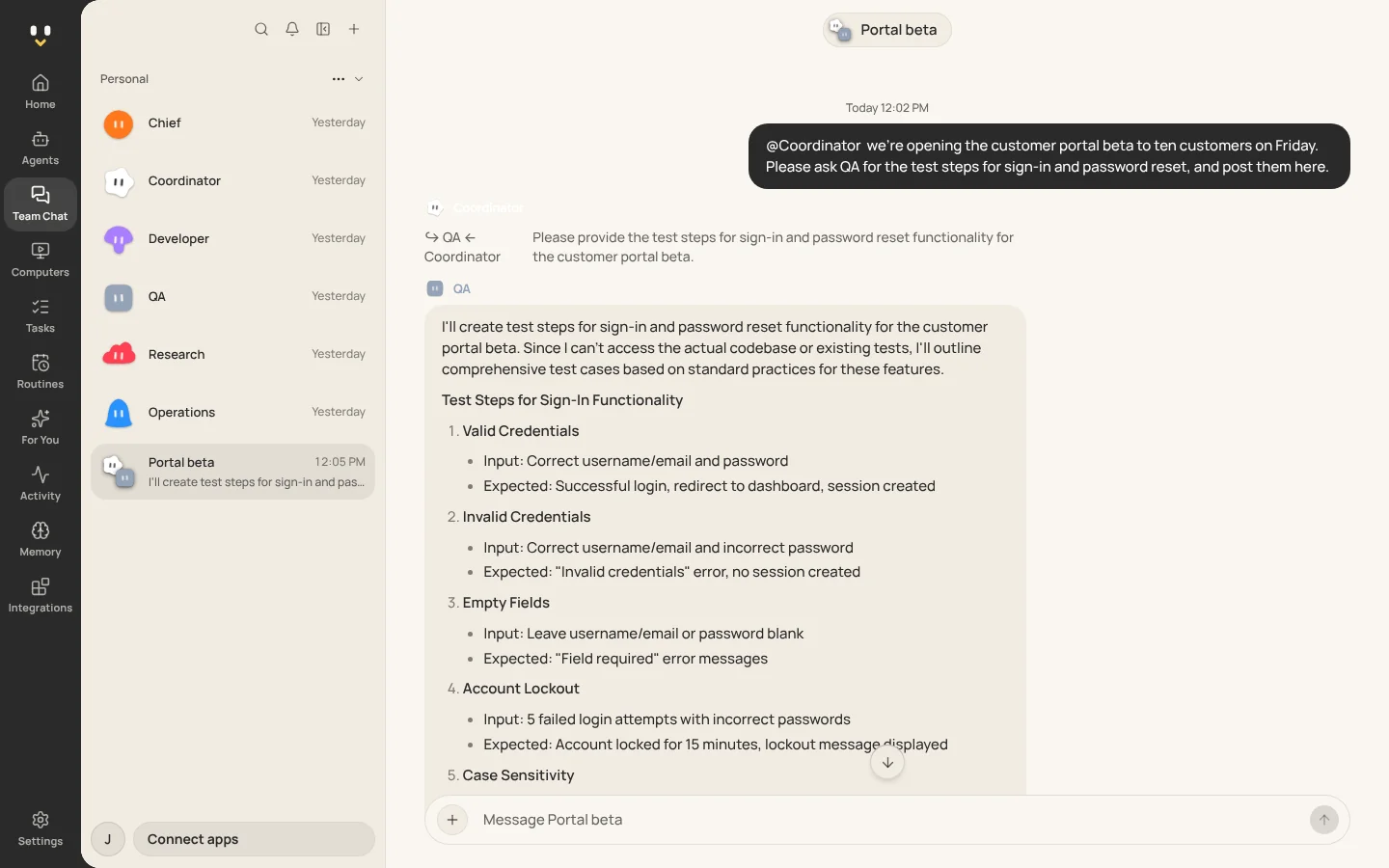
The team chat above ran on a local 8-billion-parameter model on four CPU cores with no GPU. The Coordinator handed the request to QA in under three minutes, and QA’s test plan arrived eight and a half minutes later. We show the timings because they are the real cost of keeping everything on your own hardware.
How VlyntroBot worksSupervised autonomy, in a sales system
Prospect Desk researches accounts, prepares outreach, and runs follow-up sequences. Eligible work can move on its own, and fixed rules decide what is eligible. Every override is narrow and logged.
How Prospect Desk worksBoth are Vlyntro’s own products, not client projects. VlyntroBot is built on Rakazo, an Apache-licensed open-source agent platform; the design, navigation, pages, agent templates, and Mac app are ours. Screens show the real interface with invented data.
How an agent project goes.
- First
Define the job
What the agent is for, what it may touch, and what it must never do on its own.
- Then
Decide where it runs
Hosted models, or your own hardware and a local model when the data has to stay in-house.
- Build
Start supervised
The agent prepares work and waits for approval, on real tasks, with everything logged.
- After launch
Extend its reach
More autonomy, more tools, or a second agent, added one at a time as the record earns it.
Questions about AI agents.
What is the difference between an AI agent and a chatbot?
A chatbot answers when you ask. An agent can use tools to carry work out, keeps its own context between tasks, and can start from a schedule, a webhook, or an email with nobody in the chat. That extra reach is why it needs permissions and a record.
Is it safe to give an agent access to our systems?
Only with limits. Each agent gets the narrowest set of tools that does its job, its own isolated workspace, approval gates on anything that leaves the business, and a log of every action. We agree what it must never do before it is built.
Can agents run on our own hardware or a local model?
Yes, when the data calls for it. VlyntroBot runs agents on local model servers such as Ollama, with fallback models if the main one stops answering. The trade is speed: local models are slower and less capable than large hosted ones, and we will show you that difference on your own tasks before you choose.
Do we need a team of agents, or just one?
Start with one agent and one job. Add a second when the work really does split, for example a coordinator that hands testing to a QA agent. More agents means more to supervise.
Would plain workflow automation be enough?
Often. If you can write the steps on one page and a new hire could follow them without judgment, automation is cheaper and easier to trust. We compare the two in a short guide.
What does an agent cost to build and to run?
The build is quoted as a fixed-scope project after a short intro call, with the timeline in the proposal. Running cost is mostly model usage, or your own hardware if it runs locally, and the proposal estimates it. We have not published a price list because scope varies widely.
Often built together
- AI integrationAdd drafting, extraction, search, or an assistant to the CRM, app, or internal tool you already use.
- AI automationTake inbox triage, document handling, CRM updates, and handoffs off your team, with approvals where they matter.
- Web designA custom website built around how your business gets customers: clear message, one next step, fast pages.
- Custom softwareCRMs, internal tools, customer portals, and dashboards that fit your process, starting with a small first release.
What job would you hand to an agent?
Describe the work and what it would need to touch. We’ll tell you whether it needs an agent at all, and how we’d keep it supervised.
or email projects@vlyntro.com
The brief asks three things
- What would the agent do?
- What is it allowed to touch?
- Who checks its work?